
The Quiet Strategy: How Ideas Slowly Won the War on Truth
Most of what you will find on journeytorome.com is apologetics, content aimed at helping people understand and defend the Catholic faith, often written with OCIA students in mind. This article is a little different. It does not set out to prove a doctrine or answer a common objection. Instead, it steps back and asks a bigger question: How did Western civilization drift so far from the idea that truth is real, knowable, and worth sacrificing for? The answer starts with an obscure philosophical debate in the late Middle Ages and quietly reshapes nearly everything that came after it.
There is a question worth sitting with before diving into history. What happens to a civilization when it loses confidence that truth is real? Not just that people disagree about truth, which has always been the case, but that the very idea of objective truth begins to feel like an illusion? The answer, it turns out, is not dramatic collapse. It is something slower and quieter. The foundations shift just enough that the walls above them begin to lean, and most people never notice until they are already off balance. That is the story this article tries to tell. Not through politics or personalities, but through the deeper current running beneath them. A current involving three things that are easy to take for granted until they are gone: confidence in truth, trust in rightful authority, and the willingness to sacrifice comfort in service of something greater.

History is often explained …
through politics, economics, personalities, and technology. Yet sometimes deeper forces are at work beneath the surface. When we step back and examine the major intellectual and cultural shifts in Western civilization over the past several centuries, a striking pattern begins to emerge.
Over time, confidence in objective truth weakened, trust in authority declined, and comfort gradually became one of the dominant goals of modern life. Each of these developments can be explained through normal historical processes. Yet together they form a progression that raises an intriguing question for Christians. Could there be a deeper spiritual struggle influencing these changes?
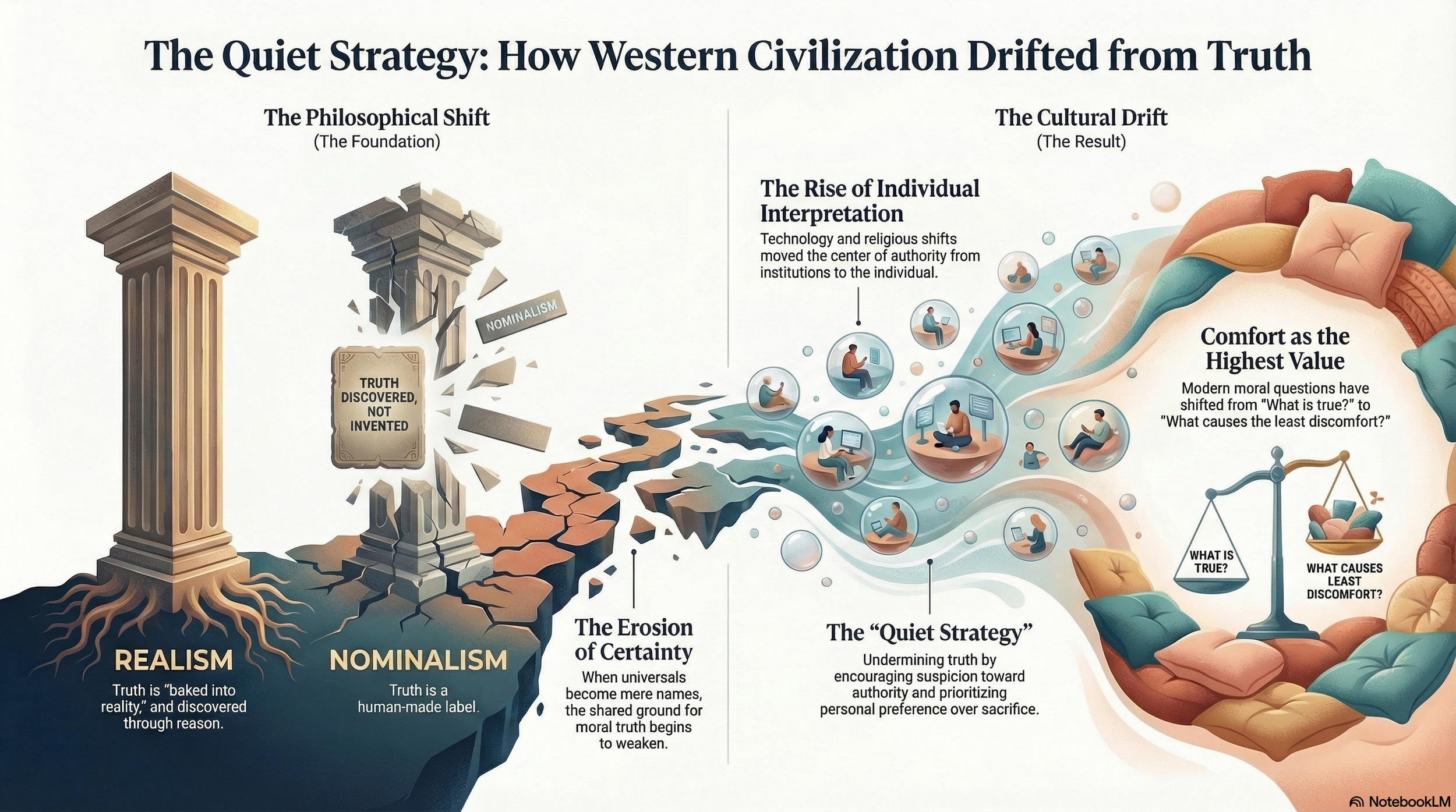
To explore that possibility, we must begin with a philosophical shift that occurred in the late Middle Ages. For much of the medieval period, Christian thought was shaped by philosophical realism. Thinkers such as Thomas Aquinas believed that universals like truth, goodness, and justice were not simply human inventions. They reflected real features of an ordered creation grounded in God. Think of it this way. When we say that torturing an innocent child is wrong, realism says that wrongness is not just our opinion. It is baked into the nature of reality itself, the way wetness is baked into water. We discovered it. We did not invent it. In this framework, truth could be discovered through reason and revelation, and institutions like the Church served as guardians and teachers of that truth.
Into this intellectual environment came the ideas associated with William of Ockham. Ockham advanced a form of nominalism, the view that universals are not real features embedded in the structure of reality but rather names we use to describe groups of individual things. On that same analogy, nominalism says that wrongness is simply a label our community agreed to attach to certain actions. A useful label, perhaps even a widely shared one, but a label nonetheless. Change the community, change the label.
At first glance this may appear to be an obscure philosophical debate. Yet its implications were profound. If universals are merely names, the grounding for shared moral truths becomes less secure. Over time, the confidence that society can clearly recognize and agree upon objective truths begins to weaken. This philosophical shift did not immediately reshape society, but it gradually altered the intellectual environment in which later debates took place. In the sixteenth century, serious reform movements emerged within Christianity. Figures such as Martin Luther raised concerns about real abuses and theological questions that many Christians were wrestling with at the time. These debates eventually contributed to what we now call the Protestant Reformation.
It is important to remember that many of the early reformers sincerely desired to restore what they believed to be authentic Christian teaching. Their intention was not to fracture Christianity but to address problems they perceived within the Church of their time.
However, once the question of interpretive authority became central, unity proved difficult to maintain. Without a universally recognized teaching authority, disagreements over doctrine multiplied over time.
Technology accelerated these developments. The invention of the Gutenberg Printing Press allowed theological debates to spread rapidly throughout Europe. Increasing literacy meant that more people could read Scripture and theological writings for themselves. This was a tremendous intellectual development, but it also shifted the center of interpretation toward individual readers.
As centuries passed, the principle of individual interpretation gradually expanded beyond theology. If individuals became the final interpreters of religious truth, it was not long before the same approach influenced broader cultural thinking.
Authority in general began to be viewed with suspicion. In modern culture, authority figures are often portrayed as manipulative, corrupt, or oppressive. While abuses of authority certainly occur and deserve correction, the broader narrative increasingly assumes that authority itself is the problem.
When confidence in objective truth weakens and authority is widely distrusted, something predictable happens. Individuals begin to function as their own ultimate authorities. Once that shift occurs, personal comfort and preference often become powerful guides for decision making. Moral questions gradually move away from asking "What is true?" toward asking "What feels right?" or "What causes the least discomfort?"
Comfort itself is not inherently wrong. Rest, enjoyment, and material stability are genuine goods. Yet when comfort becomes the highest value, difficult truths and sacrificial commitments can begin to feel unreasonable. Over time, these cultural currents reinforce one another. Confidence in objective truth declines. Authority becomes suspect. Individuals become their own primary authorities. Comfort increasingly shapes moral decisions.
From a purely historical perspective, these developments can be explained through philosophical changes, technological advances, and social evolution. Yet the Christian worldview invites us to consider another dimension as well. Scripture frequently portrays evil not as something that always attacks truth directly, but as something that subtly distorts it. Deception, confusion, and gradual drift can be far more effective than open confrontation.
If one were trying to weaken a civilization rooted in the belief that truth is real, that authority can serve and protect it, and that love often requires sacrifice, a quiet strategy might look something like this. Undermine confidence that objective truth exists. Encourage suspicion toward institutions that claim to guard truth. Promote the idea that each individual should determine truth for themselves. And gradually orient culture around comfort rather than sacrifice.
Whether these developments are simply the natural unfolding of history or part of a deeper spiritual struggle is something thoughtful people can debate. Christianity itself teaches that history unfolds within a larger conflict between truth and deception. What remains clear is that the Christian vision continues to point in a different direction. The life and teaching of Jesus Christ emphasize that truth is real, authority is meant to serve rather than dominate, and love often calls us beyond our comfort.
Recognizing these patterns does not require blaming or condemning other Christians. In fact, Catholics and Protestants today share a deep commitment to Christ and the Gospel, even while they continue to wrestle with questions of authority and interpretation. But examining the deeper philosophical and cultural currents that shaped our world may help all Christians better understand how we arrived where we are today.
And it may lead us to ask an important question.

Think of it like a house …
that has been slowly settling for generations. No single crack looks alarming on its own. The doors still close, the roof still holds, and life inside goes on more or less normally. But if no one ever asks why the floors are uneven or why the walls are pulling apart at the corners, the settling continues quietly until one day the structure can no longer bear the weight it was built to carry. That is roughly where Western culture finds itself. The cracks did not appear overnight. They opened slowly, one philosophical concession at a time, one generation of drift at a time. And just as a house is not saved by decorating over the cracks but by addressing the foundation, the Christian response is not simply to be nicer or louder but to return to the bedrock: truth is real, authority is meant to serve, and love costs something.
If the greatest spiritual battles are often fought quietly in the realm of ideas, what responsibilities do Christians have today to rediscover truth, restore trust in rightful authority, and embrace the sacrificial love at the heart of the Gospel?