

Gnosticism
1st and 2nd Centuries


Gnosticism (1st and 2nd Centuries)
What It Taught
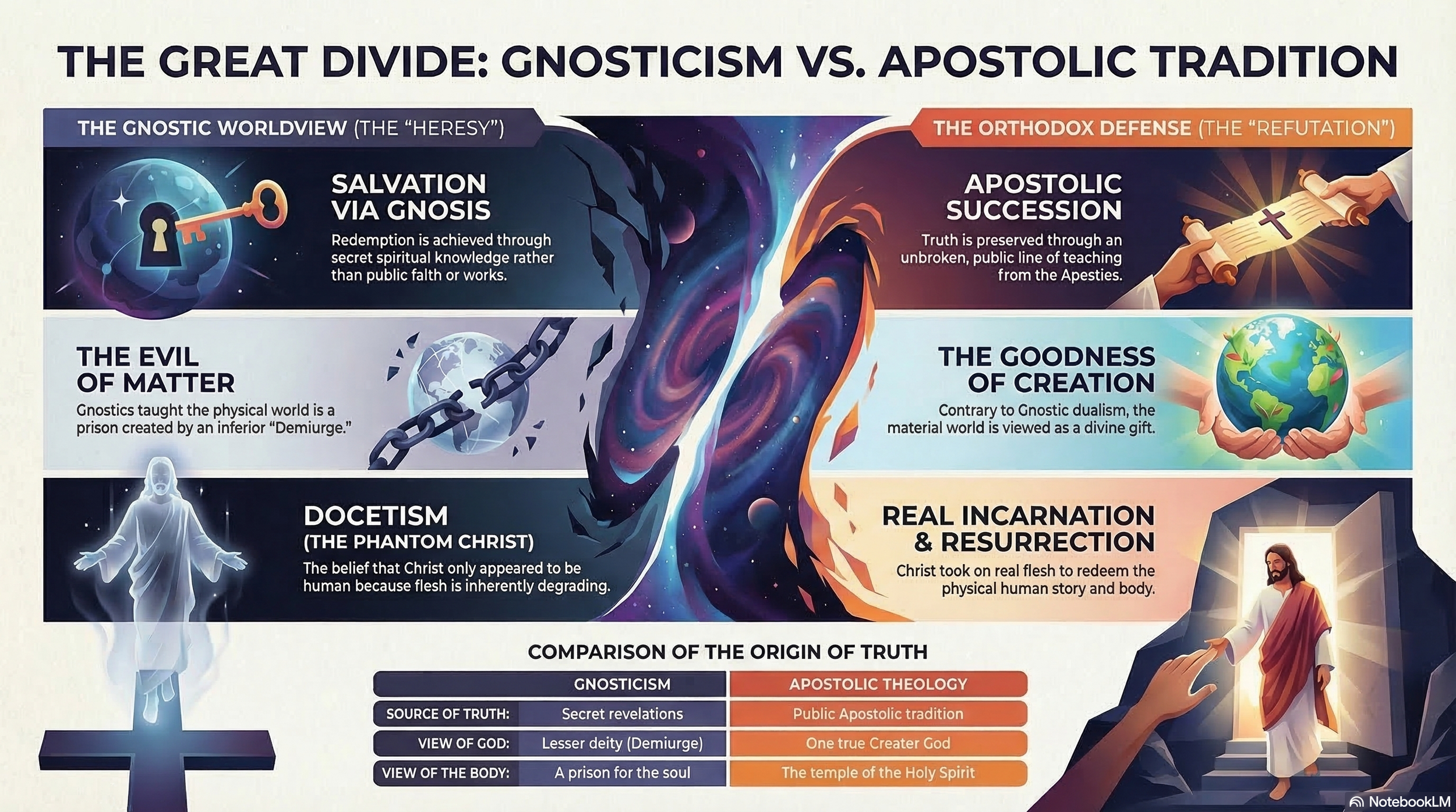
Gnosticism is not one single heresy but a whole family of them. Think of it less like a single weed and more like a weed species that keeps sprouting in different shapes. What all the varieties had in common was this central claim: salvation comes through secret knowledge. The Greek word for knowledge is gnosis, which is where the name comes from.
The Gnostics believed the physical world was a mistake. Not created by the true God, they said, but by a lesser, bungling deity they called the Demiurge. Think of him as a well-meaning but incompetent contractor who built the wrong house on the wrong lot. Matter was evil. The body was a prison. Somewhere inside each person was a divine spark, a fragment of the true God, trapped in flesh like a flame sealed inside a jar. Salvation meant escaping the jar.
Different Gnostic teachers built elaborate systems around this idea. Some described whole hierarchies of divine beings stacked above each other like floors in a cosmic skyscraper. Some took the logic about matter being evil to its conclusion and argued that Jesus never actually had a real body. A divine being, they reasoned, would never degrade himself by taking on flesh. So he only appeared to be human, the way an actor wears a costume. This particular idea got its own name: Docetism, from the Greek word meaning to seem.
Why It Was Wrong
Gnosticism does not just clip a corner of Christian teaching. It dismantles the whole structure.
Start with creation. The God of Genesis looked at what he had made and called it very good. That is not the language of a bungling sub-contractor. The world is not a cosmic accident to be escaped. It is a gift to be redeemed.
Then there is the Incarnation. If Christ only wore a human body like a costume, then the suffering was a performance and the death was theater. A phantom cannot actually die, and a death that did not happen saves nobody. The entire weight of the Gospel rests on the fact that what happened on Good Friday was real.
And if the body is evil by nature, then the resurrection of the body, which Christians have professed from the beginning, becomes not good news but a punishment. Why would anyone want to get their prison back?
Gnosticism also severed Christianity from its Jewish roots. If the God of the Old Testament was not the true God, then Abraham, Moses, David, and the prophets were all serving the wrong master, and Jesus had no connection to any of it. You cannot cut that thread without unraveling the whole garment.
The Church's Response
The most important early response came from St. Irenaeus of Lyon, who lived roughly from 120 to 200 AD. His masterwork, Against Heresies, written around 180 AD, is one of the most thorough dismantlings of a bad idea in the history of Christian writing.
Irenaeus argued that Christ did not come to help souls escape the material world. He came to restore it. Jesus took on real flesh to redeem real flesh, the same way you fix a broken watch by working on the actual watch, not by throwing it away and pretending watches do not matter.
Irenaeus also made a pointed argument about authority. The Gnostics claimed to have secret knowledge passed down through private channels. Irenaeus asked a simple question: if you want to know what the Apostles actually taught, why not just ask the churches the Apostles founded? The teaching passed down in an unbroken line from the Apostles through their successors is exactly what apostolic succession means, and it is a much more reliable source than someone's private revelation.
Lasting Consequences
Gnosticism never really went away. It kept reappearing under different names and in different centuries, like a recurring fever that breaks for a while and then returns.
Manichaeism in the 3rd century built an entire religion around the conflict between light and darkness, spirit and matter. The Cathars in medieval France taught that the physical world was the creation of an evil god and that the truly spiritual person would eventually shed the body entirely. The Church did not treat these as minor variations on Christian themes. It recognized them as the same old error wearing new clothes.
The influence did not stop in the Middle Ages. In 1974, Marshall Applewhite and Bonnie Nettles co-founded a group that would eventually become known as Heaven's Gate. Their teaching was Gnosticism dressed in science fiction: human bodies were mere containers, temporary vehicles for souls that were actually higher beings from another plane of existence. The physical world was a distraction. The body was something to be left behind. When the Hale-Bopp comet appeared in 1997, Applewhite convinced the remaining members to take their own lives, believing their souls would be transported to a spacecraft trailing the comet. All 39 members, including Applewhite, died. It is one of the most tragic illustrations in modern history of where Gnostic logic leads when followed without restraint. If the body is a prison and the material world is beneath contempt, then death stops looking like a loss and starts looking like a doorway.
The influence also shows up in quieter and more respectable ways. Any time someone says they are spiritual but not religious, and what they mean is that the invisible inner life is what really matters while the physical, communal, and institutional dimensions of faith are just getting in the way, they are thinking in categories that Gnosticism helped introduce. The church building, the sacraments, the gathered community, the bread and the wine: these are not obstacles to the spiritual life. According to Christian teaching, they are part of it.
The Church has always insisted on the opposite of everything Gnosticism assumes. The body is not a container to be discarded. It is part of who you are. The material world is not a mistake to be escaped. It is a creation to be restored. And what God redeems, he redeems whole.