Arianism
Every time you recite the Creed, you are reciting a 4th century line in the sand.
Arianism (4th Century)
What It Taught
Arius was a presbyter in Alexandria who, around 318, began teaching that the Son of God was not co-eternal with the Father but was rather the first and greatest of God's creatures. His famous formulation was that there was a time when the Son was not. The Son was divine in a derivative sense, exalted above all other creatures, but not truly God in the same way the Father was God. He was, in the Arian phrase, of similar substance to the Father, not of the same substance.
Arius was not an obscure figure at the margins. He was educated, articulate, popular with his congregation, and capable of framing his ideas in terms that sounded both philosophically sophisticated and scripturally grounded. He cited real texts: Proverbs 8:22, where Wisdom declares that the Lord created me at the beginning of his work; Colossians 1:15, where Paul calls Christ the firstborn of all creation; and John 14:28, where Jesus says the Father is greater than I. These passages required careful theological interpretation, not simple dismissal, and it was precisely the difficulty of that work that gave Arianism its staying power.
His appeal was also philosophical. How could there be two who were equally and fully God without there being two Gods? Arius thought he was protecting monotheism. He was also concerned with divine impassibility: if God cannot suffer, and the Son truly suffered and died, then the Son cannot really be God in the fullest sense. The God of Platonic philosophy was utterly transcendent, beyond all change and relation. Suffering and death were marks of creaturely limitation. Arius resolved the tension by making the Son a high-ranking intermediary rather than truly God. The logic was coherent. The conclusion was catastrophic.
Why It Was Wrong
If the Son is a creature, then Christians are worshipping a creature, which is idolatry. More devastatingly, if the Son is not truly God, then the Incarnation did not accomplish what Christians claimed. Athanasius of Alexandria, Arius's greatest opponent, stated it with precision: God became man so that man might become God. If God did not actually become man, if only a high-ranking creature did, then the deification of humanity is impossible. A creature cannot bridge the infinite distance between creation and God.
The whole structure of Christian soteriology depends on God himself entering the human condition, not merely an ambassador acting on his behalf. This is what the tradition means by deification or theosis: not that human beings dissolve into the divine, but that through union with Christ they genuinely participate in the divine life. Peter speaks of becoming partakers of the divine nature. Paul speaks of being conformed to the image of the Son. None of this works if the Son is a creature. A creature can model virtue. A creature can inspire. But a creature cannot communicate divine life, because it does not possess divine life to give. Only God can save.
There was also the matter of worship. Christians from the beginning had prayed to Christ, sung hymns to Christ, invoked his name in baptism alongside the Father and the Spirit. Pliny the Younger, a pagan Roman governor writing around 112, reported to the Emperor Trajan that Christians gathered before dawn and sang hymns to Christ as to a god. This was not a later theological imposition. It was the most primitive stratum of Christian practice. If Arianism were true, those Christians had been worshipping a creature, which is precisely what the First Commandment forbids.
The Church's Response
The Council of Nicaea in 325 condemned Arianism and defined that the Son was consubstantial with the Father, using the Greek word homoousios. This was the precise term Arius rejected. The council was called by the Emperor Constantine, who found to his dismay that the church he hoped would unify his empire was bitterly divided over the question of who Christ was.
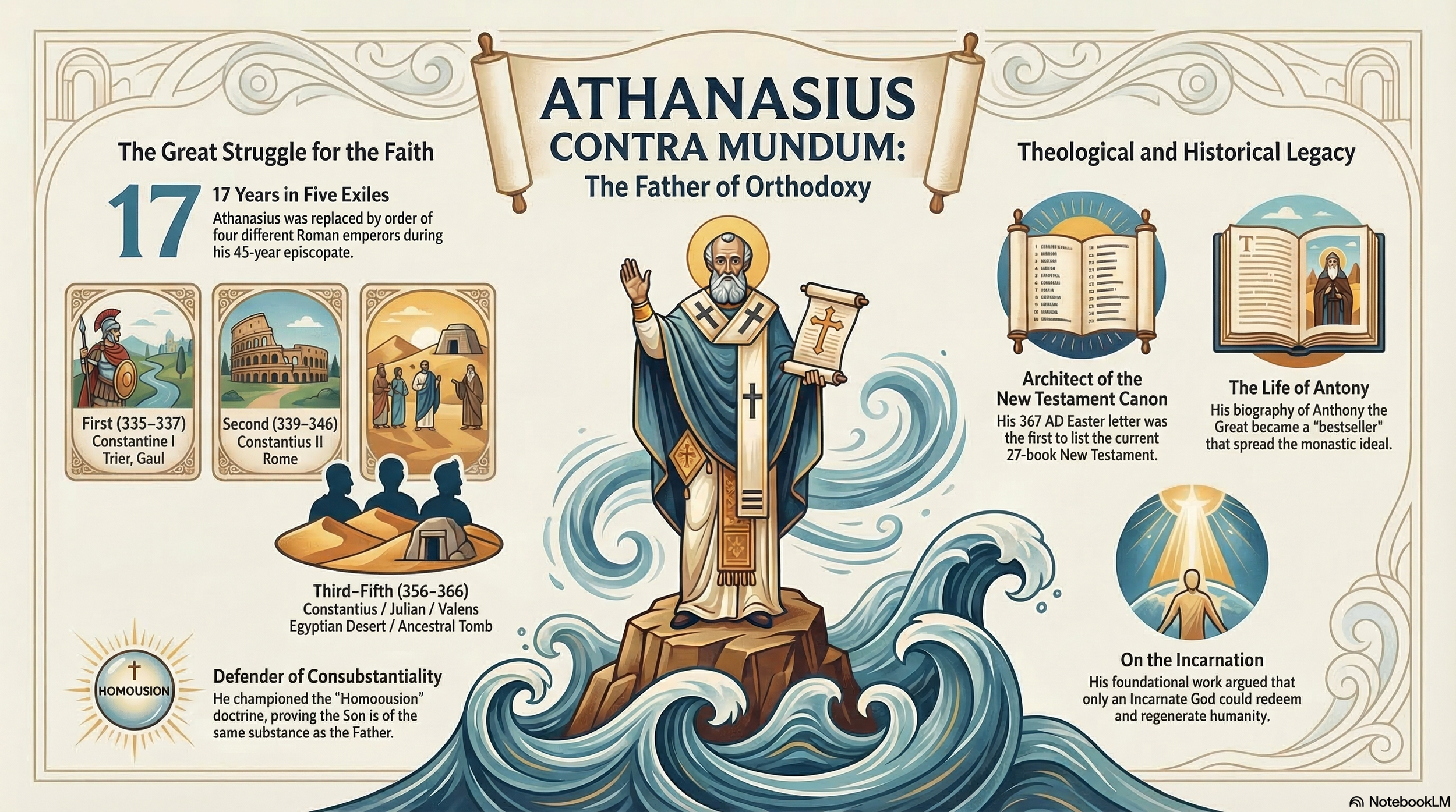
Before Nicaea could settle anything, the controversy required a formal ecclesiastical process. The Synod of Tyre in 335 illustrates how quickly theology and politics became entangled. Convened under imperial pressure, the synod condemned Athanasius on charges that were largely fabricated, including the accusation that he had murdered a bishop named Arsenius and used the man's severed hand for sorcery. Athanasius reportedly produced Arsenius alive at the proceedings, hiding hand and all, but the synod condemned him anyway and he was exiled. The episode reveals something important: the fight over Arianism was never purely doctrinal. It was fought with church politics, imperial influence, and personal slander alongside theological argument, and the orthodox were not always winning on those terms even when they were right on the theology.
The Council of Nicaea chose homoousios because it was the only term that closed off the Arian evasions. Scripture could be cited on both sides. What was needed was philosophical precision: a term that said clearly what the church had always believed, that the Son is truly and fully God. Some bishops were uncomfortable with a non-biblical word, but the council fathers understood that without it, no definition would hold.
Nicaea also exposed the earliest visible fractures between East and West. Eastern theology, formed in the Greek philosophical tradition, was more comfortable with careful metaphysical distinctions and tended to approach the Trinity by beginning with the three persons and working toward their unity. Western theology, shaped by Latin precision and more suspicious of philosophical speculation, tended to begin with the one God and work toward the three persons. These were complementary instincts, not contradictions, but they would not always be recognized as such. The controversy over homoousios, fought primarily in the Greek-speaking East, largely passed over the Latin West, where Tertullian had already established the language of one substance and three persons a century earlier. The different theological starting points, the different vocabulary, and the different relationship to imperial politics in East and West all widened during the Arian crisis, laying groundwork for tensions that would not fully surface for centuries.
The aftermath of Nicaea was turbulent. Arianism had political support, especially among the Germanic peoples, and there were periods in the fourth century when Arian or semi-Arian bishops outnumbered orthodox ones. St. Jerome famously remarked that the whole world groaned and marvelled to find itself Arian. Athanasius spent much of his life in exile for defending Nicene orthodoxy, exiled five times by four different emperors, giving rise to the phrase Athanasius contra mundum: Athanasius against the world. He continued to write and organize throughout, and his tenacity was the instrument by which Nicene theology survived decades of imperial pressure.
The Council of Constantinople in 381 reaffirmed Nicaea and completed the definition of Trinitarian doctrine. The Cappadocian Fathers, Basil of Caesarea, Gregory of Nazianzus, and Gregory of Nyssa, had by then clarified the distinction between substance and person: one ousia, three hypostases. The legitimate philosophical concerns about monotheism that had given Arianism its initial appeal were answered not by abandoning precision but by deepening it.
Lasting Consequences
(The good ones first)
The Arian crisis forced the church to articulate with unprecedented clarity what it had always believed. The Nicene Creed, finalized in its present form at Constantinople in 381, is the most consequential theological document in Christian history outside of scripture itself. It is recited every Sunday in Catholic, Orthodox, and many Protestant churches across the world. Its central affirmation, that the Son is God from God, Light from Light, true God from true God, begotten not made, consubstantial with the Father, is a direct and deliberate refutation of Arianism. Every phrase was chosen to close an Arian escape route. What looks like liturgical poetry is in fact a precise theological fortress built from the ruins of a century of controversy.
The crisis also produced some of the greatest theological writing in Christian history. Athanasius's On the Incarnation, written before the controversy fully erupted, remains one of the most lucid and beautiful defenses of the full divinity of Christ ever composed. The Cappadocians developed a Trinitarian theology of such depth and precision that it shaped all subsequent Christian thinking about the nature of God. Gregory of Nazianzus's Theological Orations are still studied and quoted. The pressure Arianism applied to orthodox theology did not weaken it. It refined it.
The crisis also deepened the church's understanding of its own conciliar authority. Nicaea established the principle that a gathering of bishops from across the Christian world, speaking in council, could define doctrine with binding force. This was not self-evident before Nicaea. It became foundational afterward.
The negative consequences were also substantial. Arianism shaped European history in ways that outlasted the theological controversy. The Visigoths, Ostrogoths, Vandals, and Lombards were all Arian Christians when they entered the Roman world. Their conversion in Arian form was largely the work of Ulfilas, a fourth-century missionary bishop who translated the Bible into Gothic and carried an Arian Christianity into the Germanic world. The conflict between Arian Germanic rulers and Catholic Roman populations was a persistent tension for centuries. The conversion of the Franks under Clovis at the end of the fifth century was pivotal precisely because Clovis converted directly to Catholic Christianity, giving the Frankish kingdom a natural alliance with Rome and laying the political foundation of medieval Catholic Europe.
Arianism as a formal movement faded, but the underlying impulse reappears wherever the Son is reduced to something less than fully divine. The Jehovah's Witnesses are essentially Arian, their New World Translation rendering John 1:1 as the Word was a god, placing the Son in the Arian category of a divine but secondary being. More broadly, a Jesus who is the greatest moral teacher, the supreme example of human potential, the highest expression of God's love in human form, but not himself truly God, is functionally an Arian Jesus even if the word is never used. This tendency runs through a great deal of popular Christian language and preaching wherever the weight of Nicaea has been quietly set aside in favor of something less demanding.
The stakes are the same as they were in the fourth century. If the Son is not truly God, then what happened on Calvary is a noble human death, not the self-offering of God himself for the redemption of creation. A creature cannot bridge the infinite distance between creation and the Creator. Only God can save, and only if the Son is truly God did salvation actually happen. Nicaea did not invent that claim. It defined it precisely enough that it could never be quietly abandoned without being clearly contradicted.

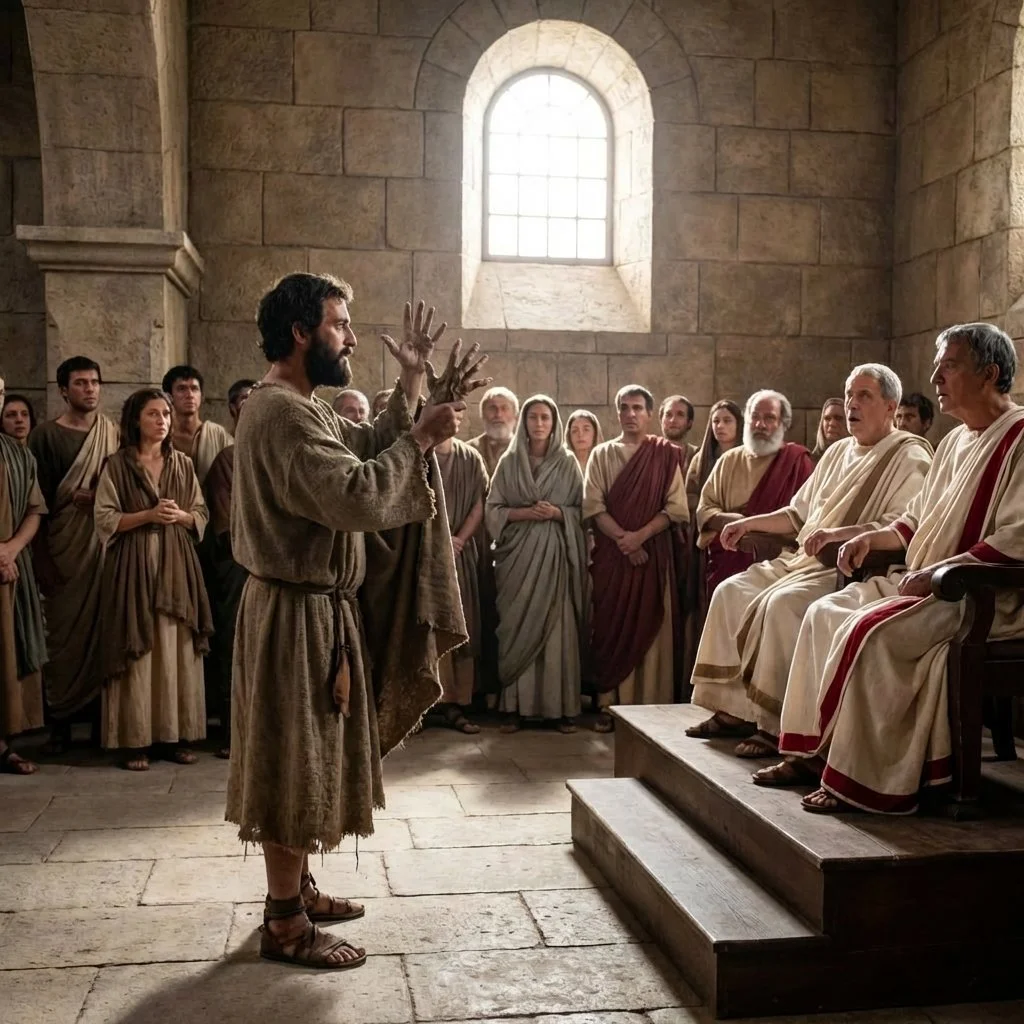
During the Arian controversy, Athanasius was falsely accused of murdering Bishop Arsenius, with his accusers even producing a severed hand as supposed proof. The irony, though, was that when Arsenius returned unharmed, everyone laughed at the idea that he must have grown a third hand, fooling even his would-be killers.

As the battle over Arianism raged, it began to reveal deeper cultural differences between East and West, especially in how theology was debated and interpreted. The Eastern Church, with its Greek philosophical traditions, clashed with the Western Church’s more straightforward, legalistic style, shaping a divide that would echo for centuries.

It was incredibly difficult for the Catholic Church to pin down clear doctrine on the Trinity, as the debate was tangled in political intrigue, personal rivalries, and shifting allegiances. Yet, through this trial, the Church ultimately prevailed, and a clear, orthodox definition emerged, underscoring the enduring guidance of the Holy Spirit in preserving the unity of faith.