
Marcionism
(2nd Century)

Marcionism (2nd Century)
What It Taught
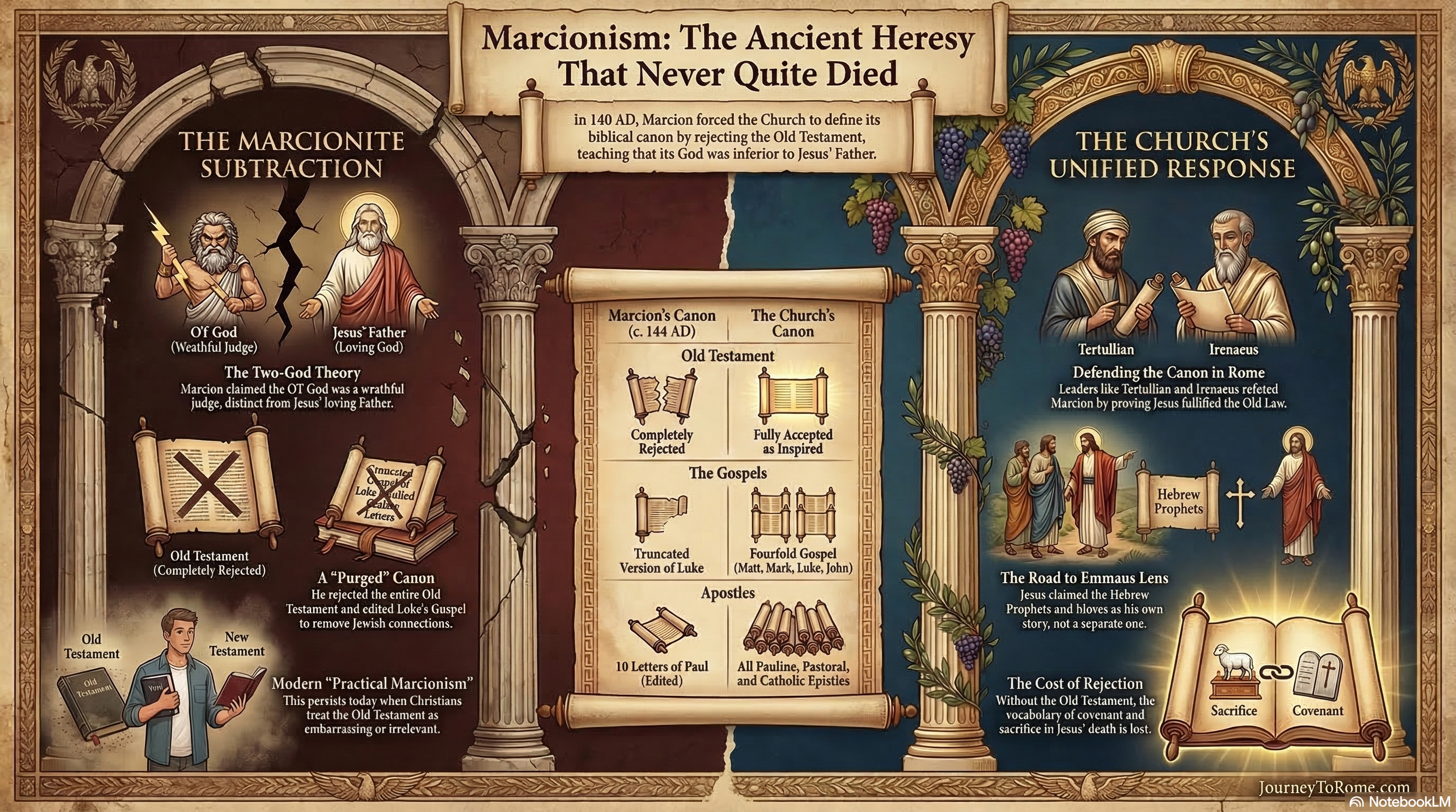
Marcion of Sinope arrived in Rome around 140, was initially welcomed by the Christian community there, and developed a streamlined version of the Gnostic rejection of the Old Testament. He was excommunicated from the Roman church around 144. He taught that the God of the Hebrew Bible, the wrathful judge who commanded genocide and demanded blood sacrifice, was a completely different God from the loving Father whom Jesus revealed. Jesus came to rescue humanity from the Jewish God, not to fulfill his law.
Marcion produced one of the first known Christian canons, but it was radically edited. He accepted only a truncated version of Luke’s Gospel and ten of Paul’s letters, having purged everything that connected Christianity to Judaism. He excluded the Pastoral Epistles, the letter to the Hebrews, and all the other letters, and naturally rejected the entire Old Testament.
Why It Was Wrong
Marcion's error was to read the Old Testament woodenly and without the typological lens that Jesus himself applied to it. When Jesus said on the road to Emmaus that Moses and all the prophets spoke of him, he was not embarrassed by those Scriptures. He claimed them. The God who spoke to Abraham, who led Israel out of Egypt, who gave the law to Moses, and who sent the prophets, is the same God whose eternal Son became flesh in Bethlehem.
Moreover, Marcion's surgical approach to Scripture demonstrated exactly why an authoritative teaching church was necessary. Marcion could not simply be defeated by pointing to a text, because he had excised the texts that defeated him. The Church's response had to invoke something prior to and deeper than any individual's reading of Scripture.
The Church's Response
The encounter with Marcionism was one of the driving forces behind the formation of the biblical canon. By the late second century, the Church was articulating a list of authoritative books, and the criterion was apostolic origin and continuity with the Old Testament. Irenaeus again was central, as was Tertullian (c. 160 to 220), who wrote a five-volume refutation called Against Marcion.
Lasting Consequences
Marcionism is formally dead, but a practical Marcionism persists wherever Christians treat the Old Testament as dispensable, embarrassing, or irrelevant to Christian life. Any theology that presents the God of the Old Testament as fundamentally different in character from the God revealed by Jesus is replaying Marcion’s error, whether it knows it or not.
And that replay happens constantly. Many Christians today, without ever having heard the name Marcion, hold precisely his central assumption: that the God of Genesis and Exodus is a God of wrath, while the God of the Gospels is a God of love. They function with a practical two-God theology, even while formally professing one. They rarely open the Old Testament, and when they do, they find it uncomfortable in ways they do not quite know how to address. This is not a fringe problem. It is one of the most common distortions of Christianity in the modern world.
It shows up in the impulse to reduce Christian faith to the words of Jesus alone, as though Paul’s letters and the Hebrew prophets were optional commentary rather than the same inspired Word of God spoken across different moments of the same unfolding story. It shows up in any theology that presents Jesus as arriving to rescue humanity from the harsh God of the Old Testament, rather than as the fulfillment of everything that God had been promising since Eden. It shows up whenever the Church’s difficult passages, the conquest of Canaan, the psalms of vengeance, the hard edges of the law, are treated as problems to be explained away rather than as pieces of a larger revelation that only make full sense in light of the Cross.
The irony is that this approach does not produce a gentler Christianity. It produces a rootless one. Strip away the Old Testament and you lose the Passover, the Exodus, the temple, the priesthood, the sacrifice, the covenant, and the entire typological architecture on which the Incarnation and the Eucharist make sense. You are left with a Jesus who appeared out of nowhere, made some inspiring remarks, and died for reasons that are difficult to explain with any precision, because you have already discarded the vocabulary of atonement, covenant, and sacrifice that gives his death its meaning.
When Jesus walked with the disciples on the road to Emmaus and explained to them how Moses and all the prophets spoke of him, he was not embarrassed by those Scriptures. He claimed them. He read them as his own story. A Christianity that does less is not a simplified version of what Jesus taught. It is a subtraction from it, and it is one that Marcion proposed in the second century, was condemned for, and has been quietly reintroducing ever since.