Montanism
A Fire That Refused the Hearth

What It Taught
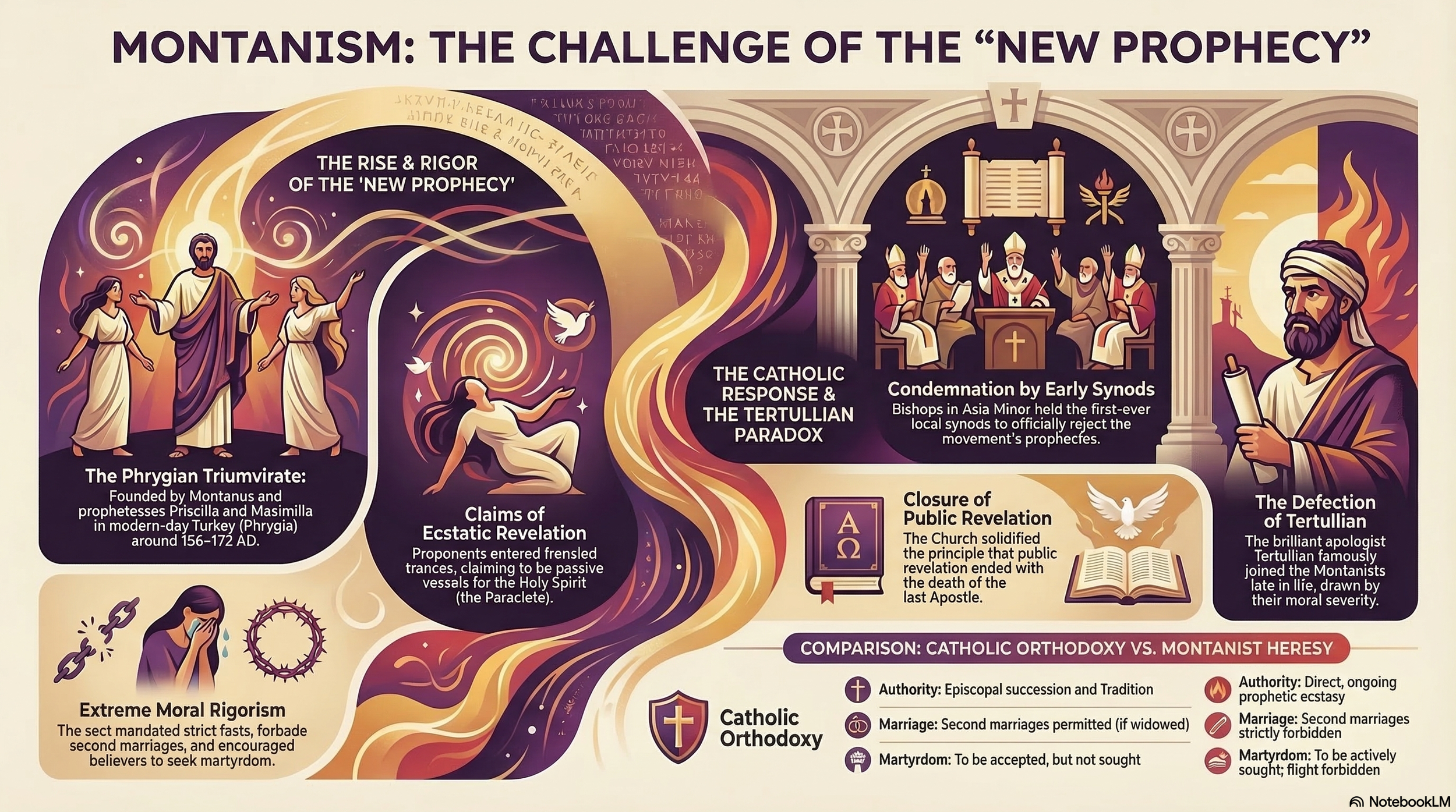
Around 156, or possibly as late as 172 by other ancient accounts, a man named Montanus in Phrygia (modern Turkey) began claiming direct prophetic inspiration from the Holy Spirit, along with two prophetesses, Prisca and Maximilla. They taught that a new age of the Spirit had dawned, superseding the institutional church. Revelation was still ongoing. Strict asceticism was required. Martyrdom was to be sought, not avoided. The end of the world was imminent.
Why It Was Wrong
The central problem with Montanism was its claim that private prophetic revelation could supersede the apostolic deposit of faith. If any charismatic figure can claim new revelation that overrides what the Church has received and handed on, then the apostolic tradition is not really a foundation; it is just one voice among many. The Apostle Paul had already warned the Galatians: even if an angel from heaven should preach to you a gospel other than the one we preached, let that one be accursed.
Montanism also elevated spiritual enthusiasm over doctrinal order, which tended in practice to lead wherever enthusiasm went. The severe asceticism and the mandatory pursuit of martyrdom were pastoral disasters.
The Church's Response
Various synods in Asia Minor condemned Montanism in the late second century. The response helped solidify the principle that public revelation closed with the death of the last Apostle. Private revelations, even authentic ones, cannot add to or contradict the deposit of faith.
Lasting Consequences
Tragically, Montanism claimed one of its most brilliant victims late. Tertullian, who had written so incisively against Marcion and the Gnostics, eventually joined the Montanists in his later years. He never returned to full communion. The impulse Montanism represents, the desire for a purer, more charismatic, more spiritually elite community outside the institutional church, has recurred repeatedly throughout Christian history.
It is alive today in any Christian movement that places private revelation, prophetic utterance, or direct personal experience of the Spirit above the authority of the Church’s defined teaching. The pattern is recognizable: an individual or community claims a fresh outpouring of the Holy Spirit, the new revelations intensify over time, and gradually the institutional church is recast as cold, bureaucratic, or spiritually dead compared to those who have received the new prophecy. What begins as genuine spiritual enthusiasm can drift toward a two-tier Christianity, the truly spiritual versus the merely observant, which is precisely the division the Montanists introduced.
The Church’s settled principle, reaffirmed in every age, is that public revelation closed with the death of the last Apostle. Private revelations, even authentic ones, can illuminate or encourage, but they cannot add to or contradict the deposit of faith. A sense of spiritual intensity is not the same thing as doctrinal authority. Montanus thought he had both. That confusion is not ancient history.