Pelagianism
A Light Kindled by Human Hands

What It Taught
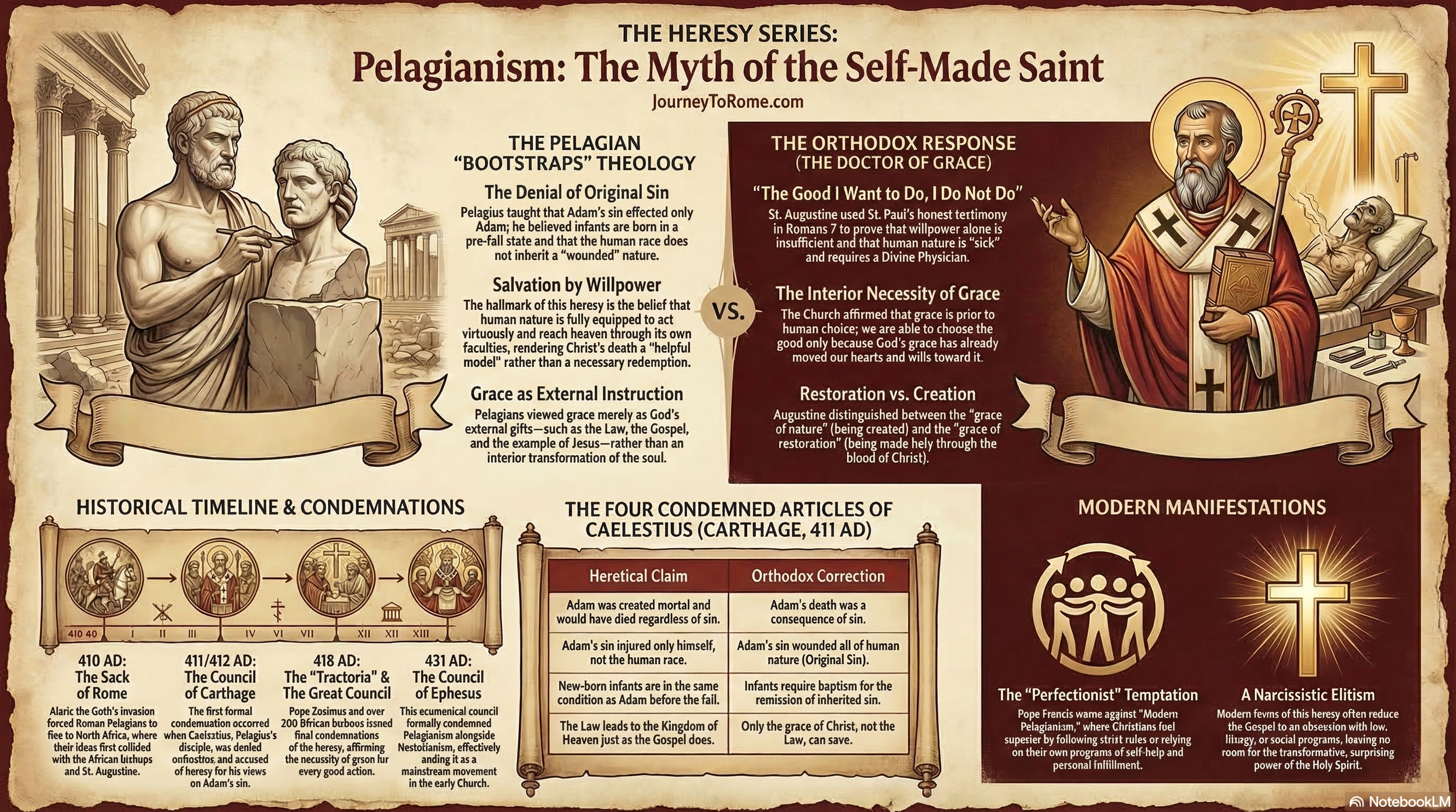
Pelagius was a British monk who came to Rome around 380 and was alarmed by the moral laxity he found there. He concluded that the problem was theological: people believed that sin was so deeply woven into human nature that they could not really help themselves. Against this, Pelagius insisted that human beings have a free will fully capable of choosing good, that Adam's sin affected only Adam himself and not his descendants by inheritance, and that grace was essentially God's instruction and example rather than an interior transformation of the soul. People could, if they tried hard enough, live without sinning.
Why It Was Wrong
Pelagianism flatters human nature at the expense of grace. If we can save ourselves by trying hard enough, then Christ's death was not strictly necessary, and the sacraments are merely helpful accessories. The entire structure of Catholic sacramental theology, which holds that grace is a real participation in the divine life communicated through the sacraments, collapses if Pelagius is right.
It also flatly contradicts experience. Anyone who has seriously tried to live a holy life knows that willpower alone is insufficient. The struggle Paul describes in Romans 7, the good I want to do I do not do, while the evil I do not want to do, that I keep doing, is not the complaint of a lazy man making excuses. It is the honest testimony of someone who has discovered that he needs more than good intentions.
The Church's Response
St. Augustine of Hippo (354 to 430) was Pelagianism's greatest opponent. Drawing on his own wrenching personal experience of moral failure and conversion, he developed the Catholic theology of grace: that fallen human nature is wounded and requires God's grace not merely to be instructed but to be healed and elevated. Grace is prior to human choice; we choose the good because God has already moved our will toward it. The Council of Carthage in 418 and the Council of Ephesus in 431 both condemned Pelagius.
Lasting Consequences
Pelagianism is the most natural heresy in the world. The idea that we can earn our way to God by moral effort is deeply embedded in human intuition. It resurfaces in every era as a kind of Christian moralism that replaces the mystery of grace with a program of self-improvement. Semi-Pelagianism, the slightly softer version that grants that grace is needed but insists that the first step toward God must come from us, was condemned at the Council of Orange in 529, but it too keeps returning.
It is perhaps the dominant functional theology of Western culture today, Christian and non-Christian alike. The assumption that sufficiently sincere effort, moral seriousness, and good intentions are what matter in one’s relationship with God, and that grace is what God provides to people who have already decided to try, is Semi-Pelagianism with a contemporary vocabulary. The sacraments become support tools for people already on the right track rather than lifelines for people drowning. Confession becomes a formality for the sufficiently self-aware rather than an encounter with mercy that accomplishes something objectively real. The Eucharist becomes a communal affirmation rather than the actual Body of Christ given for actual sinners who actually need it.
The Catholic response in every age is the same one Augustine gave: grace is not a reward for effort. It is what makes effort possible. We do not first decide to turn toward God and then receive his assistance. God moves first, always, because if he did not, nothing would move at all. That is not a discouragement to human effort. It is the only foundation on which genuine human effort can stand without collapsing into either pride or despair.