
Ignatius: Bishop of Antioch
From the Feet of John the Apostle to the Gates of Martyrdom
Battling The Very Early Heresies
The Early Heresies and Ignatius of Antioch (c. 107 AD)
Before the councils, before the creeds, before the formal vocabulary of orthodoxy had been hammered out in the heat of controversy, the Church was already fighting for the truth of who Jesus Christ was. The story of Christian heresy does not begin with Arius in the fourth century or with the great Gnostic systems of the second. It begins in the first generation after the apostles, in the letters of a bishop on his way to be eaten by lions.
Ignatius of Antioch is not a household name among most Catholics today, but he should be. He stands at one of the most revealing moments in the entire history of the Church: close enough to the apostles to preserve their voice, far enough along to see the first real fractures forming. What he fought in 107 AD, the Church was still formally defining three hundred years later. That continuity is not a problem to explain away. It is one of the most powerful arguments for the authenticity of Catholic doctrine.
The World Ignatius Inhabited
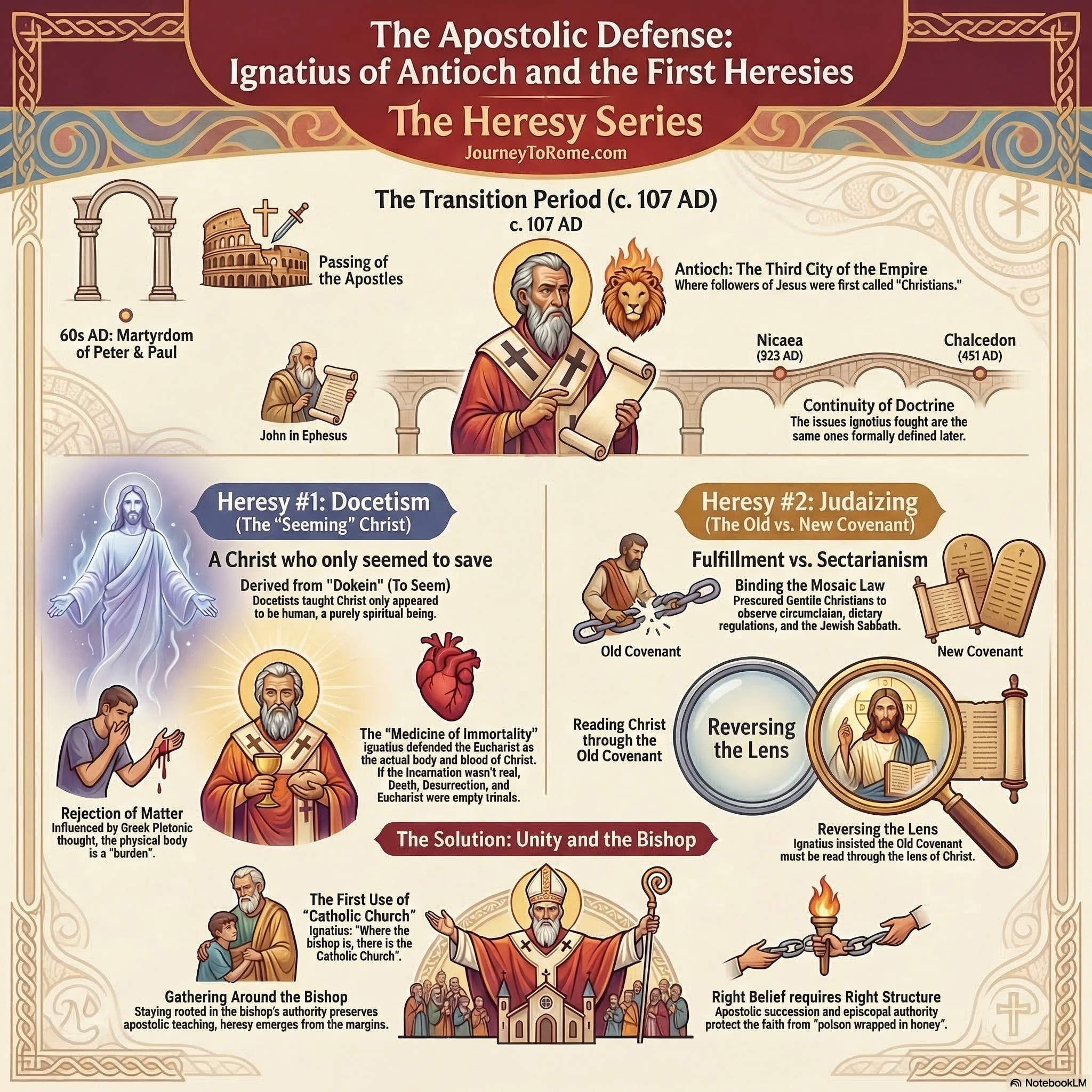
The Church in the late first and early second century was not a settled institution with clear boundaries and a defined canon of scripture. It was a network of communities spreading across the Roman Empire, bound together by apostolic teaching, shared worship, and the authority of bishops who traced their office back to the apostles themselves. Ignatius was bishop of Antioch, the third city of the empire and one of the earliest centers of Christian life. It was in Antioch that followers of Jesus were first called Christians.
The apostolic generation was passing. Paul had been martyred, probably under Nero around 67 AD. Peter had died in Rome around the same time. John, the last surviving apostle, was aging in Ephesus. The living link to the eyewitnesses of the Resurrection was growing thin, and into the space left by their passing, distortions began to appear.
Two in particular pressed hardest on the communities Ignatius knew: a teaching about the nature of Christ that denied the reality of his humanity, and a pressure from within Jewish Christian circles to retain the Mosaic Law as binding on all believers. Neither was entirely new. Both had roots in controversies the apostles themselves had addressed. But without the apostles present to correct them in person, these tendencies were spreading in new and more systematic forms.
The Heresy of Docetism
The word comes from the Greek dokein, meaning to seem or to appear. Docetists taught that Christ only appeared to be human. He did not actually take on flesh, did not actually suffer, did not actually die. What the disciples witnessed was a divine being who wore humanity like a costume, a spiritual reality projecting the image of a body for the sake of those too limited to perceive pure spirit.
The appeal was partly philosophical and partly devotional. The Greek intellectual tradition, drawing on Platonic thought, tended to regard matter as inferior to spirit, the body as a prison or a burden rather than something good. For people formed in that tradition, the idea that the eternal divine Word truly became flesh, truly sweated and bled and died, was not just difficult to believe. It was almost offensive. Surely God was above all that. Surely what happened on Calvary was something more refined, more spiritual, than an actual human death.
The devotional appeal was subtler. A Christ who only seemed to suffer does not really suffer with us. But there was comfort in the idea of a purely spiritual savior, untouched by the ugliness of physical existence, drawing souls upward out of the material world rather than redeeming the material world from within.
The problem, as Ignatius saw with perfect clarity, is that a Christ who only seemed to suffer only seems to save. If the Incarnation was not real, then nothing that followed it was real either. The death was not real. The Resurrection was not real. The Eucharist, which Ignatius calls the medicine of immortality, is not the body and blood of the one who suffered for our sins but an empty ritual. Docetism does not merely trim Christianity at the edges. It guts it entirely.
Ignatius had no patience for softening this point. Writing to the Smyrnaeans, he insists that Christ was truly of the line of David according to the flesh, truly born of a virgin, truly nailed to a cross in the flesh, truly raised from the dead. He uses the word truly repeatedly and deliberately, because the entire point is that these things actually happened, in history, in a real body, to a real person who was also truly God. He warns his readers to stay away from those who hold otherwise, noting that their teaching is a kind of poison wrapped in honey.
The Pressure of Judaizing
The second front Ignatius was fighting was different in character. Judaizing did not deny the reality of Christ's humanity. It questioned the sufficiency of the New Covenant by insisting that Gentile Christians remain bound to the Mosaic Law, including circumcision, dietary regulations, and sabbath observance.
This tension was not new. It had erupted early enough that Paul addressed it with some heat in his letter to the Galatians, and it had been the subject of the first formal gathering of church leadership, the Council of Jerusalem around 49 AD, recorded in Acts 15. That council had ruled clearly: Gentile believers were not required to be circumcised or to take on the full burden of the Mosaic Law. The Holy Spirit and the apostles had reached a decision, and it was binding.
But the question did not stay settled. Judaizing tendencies persisted into the second century, and by Ignatius's time they had taken on a new and somewhat different form. The issue was no longer simply whether Gentiles needed to be circumcised. It had become a broader question about the relationship between the old covenant and the new, between Jewish Christian practice and the emerging identity of a Church that was increasingly Gentile in composition. Some were insisting on reading the scriptures through the lens of Jewish interpretive traditions in ways that effectively made Jewish practice normative for all Christians.
Ignatius's response in his letter to the Philadelphians is pointed. It is absurd, he writes, to profess Jesus Christ and to practice Judaism. Christianity did not grow out of Judaism in the sense of being a sect within it. It fulfilled and superseded it. The scriptures of Israel find their meaning in Christ, not the other way around. To read Christ through the lens of the old covenant rather than reading the old covenant through the lens of Christ is to read everything backward.
Unity Under the Bishop
Running through all of Ignatius's letters is a third concern that is inseparable from the first two: the authority of the bishop and the unity of the Church gathered around him. This is not an administrative concern dressed up as theology. For Ignatius it is directly theological, and the connection to heresy is direct.
Heresy, in his observation, does not typically emerge from communities that are firmly rooted in apostolic authority. It emerges from the margins, from those who have separated themselves from the bishop and the eucharistic assembly, who gather privately, who substitute their own teaching for the teaching handed down from the apostles. Docetism and Judaizing were both, in his experience, associated with schismatic tendencies, with groups pulling away from the common life of the Church.
His instruction is therefore not merely to believe correctly but to stay together, to gather around the bishop as the Church gathers around Christ, to treat a Eucharist celebrated without the bishop or his authorization as suspect. Where the bishop is, there is the Catholic Church, he writes in his letter to the Smyrnaeans. This is, incidentally, the first recorded use of the phrase Catholic Church in Christian literature.
Ignatius is not inventing episcopal authority. He is defending what already exists and already feels threatened. The connection between right belief and apostolic structure is for him a single thing: you cannot have one without the other, because the apostolic structure is precisely the instrument by which right belief is preserved and passed on.
What Came Next
Ignatius was martyred in Rome, probably around 107 AD, thrown to the beasts in the arena as he had anticipated and indeed desired. His letters circulated widely and influenced the next generation of Christian writers. Polycarp of Smyrna, who had known the apostle John personally and who would himself be martyred in old age, continued defending the same apostolic teaching. Justin Martyr engaged both pagan philosophy and heretical distortions with considerable sophistication. The issues Ignatius named did not go away. They intensified.
Docetism fed into the broader Gnostic systems that flourished in the second century, elaborate theological constructions that posited a hierarchy of divine emanations, a creator God inferior to or distinct from the true God, and a Christ who came to deliver souls from the prison of matter rather than to redeem matter itself. These systems were far more sophisticated than early Docetism, but they were built on the same foundational rejection of the Incarnation as a real, physical, historical event.
The Church responded by doing what Ignatius had already pointed toward: clarifying apostolic succession, defining the canon of scripture, and strengthening episcopal authority as the structures by which authentic teaching was preserved against innovation. These were not new inventions. They were the explicit development of what was already present in embryonic form in Ignatius's letters.
The trajectory runs in a straight line. The Council of Nicaea in 325 defined the full divinity of Christ against Arianism. The Council of Chalcedon in 451 defined his full humanity against the various forms of monophysitism that had arisen in the intervening centuries. Both definitions are, at their core, finishing the work Ignatius had started: insisting against every philosophical and spiritual temptation that Jesus Christ was truly God and truly man, that the Incarnation was real, that what happened on Calvary actually happened, and that everything the Church is and does depends on that reality being exactly what the apostles said it was.
The problems Ignatius fought in 107 AD are the same problems the Church was still formally defining three centuries later. That is not a sign of confusion or slow development. It is a sign of continuity. The Church did not invent these doctrines when the councils defined them. It defended and clarified what was already there, under pressure, from the beginning.